
The Climate Policy Landscape Just Got Complicated
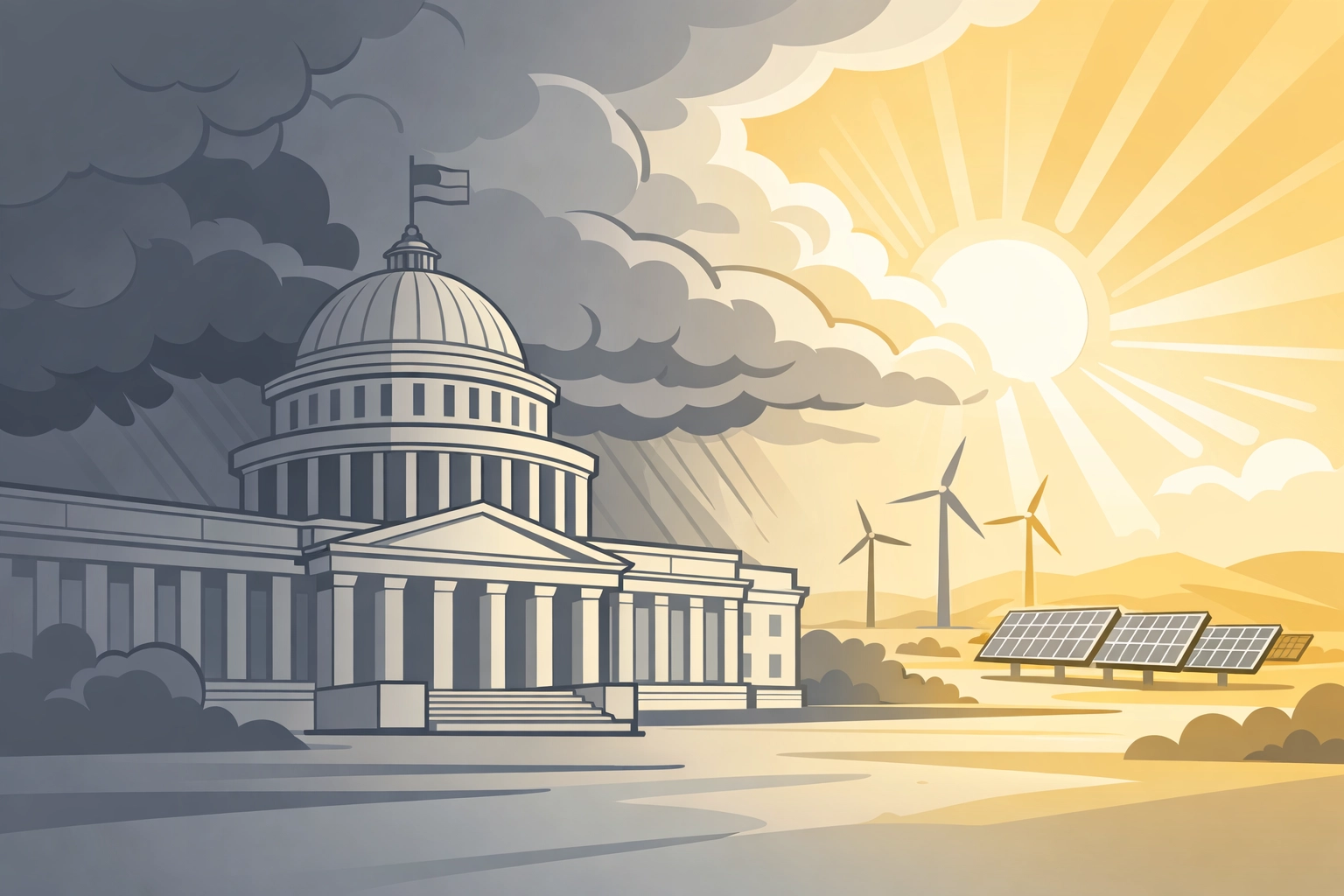
If you've been tracking government climate action lately, you've probably noticed things are moving in some unexpected directions. The Trump Administration has officially abandoned the 2050 net-zero emissions target that was set during the Biden years, and that's just the beginning of a wave of policy reversals reshaping the U.S. climate landscape in 2026. The One Big Beautiful Bill (OBBB), signed in July 2025, eliminated most of the clean energy tax credits that were introduced by the 2022 Inflation Reduction Act: we're talking about cuts to clean electricity, renewable fuels, EVs, and industrial clean energy incentives. Wind and solar developers are now racing against a July 2026 deadline to begin construction if they want to qualify for remaining tax credits, and cumulative renewable capacity additions are projected to be cut in half by 2035 compared to previous estimates.
Federal Lands, Permitting, and the Fossil Fuel Push
Here's where things get even more interesting: the Department of the Interior paused approvals for new renewable energy projects on federal lands and waters back in January 2025, even though federal lands alone could support 5,750 GW of solar and 875 GW of wind capacity. Meanwhile, the Trump Administration rolled out expedited permitting procedures that can cut multi-year approval processes down to just 28 days maximum: but here's the catch, those fast-track procedures only apply to oil, gas, coal, and petroleum projects. Wind and solar are explicitly excluded. The Interior Department is also proposing a massive offshore oil and gas leasing program for 2026-2031 that could include up to 34 lease sales covering roughly 1.27 billion acres. And if you're wondering about EV infrastructure, the Alternative Fuel Vehicle Refueling Property Credit is getting eliminated in June 2026, which will slow down charging station deployment despite the fact that the U.S. grew publicly accessible EV charging points by 85% since the IRA, hitting over 230,000 stations by August 2025.
EPA Reviews and the Endangerment Finding Drama
The EPA is currently reviewing multiple greenhouse gas regulations with final rules expected in early 2026, including reconsideration of vehicle emission standards and power plant emission rules. The Trump Administration is also proposing to repeal the 2009 endangerment finding: that's the ruling that classified greenhouse gases as a public health threat under the Clean Air Act. But efforts to overturn it have stalled due to anticipated legal challenges, and officials have been delaying the repeal announcement because it's way more complicated than it sounds. Legal experts expect this to turn into a multi-year court battle if the administration pushes forward, which could create regulatory uncertainty for businesses trying to plan their climate strategies.
States Are Picking Up the Slack
Despite all the federal rollbacks, it's not all doom and gloom. State and local policies have historically accounted for about 40% of new solar and wind capacity deployed since 2000, and that trend is continuing. California released draft updates to its Cap-and-Invest climate program in January 2026 to help the state meet its 2030 and 2045 climate targets, and other states are following suit with their own initiatives. Global renewable energy investment is still accelerating, and international cooperation continues with COP 31 scheduled to convene in Antalya, Türkiye. For a deeper dive into all these developments and what they mean for climate policy, check out the analysis from Columbia University's Center on Global Energy Policy, which has been tracking these changes in real time.
